Sökte men hittade inte att denna sida har länkats till förut. Handlar om hur trevligt det är med hävstång på diversifierade portföljer, och varför man inte borde köra med hävstång på 100% aktier. Och här rör det sig ändå om en klassisk 60/40-portfölj som är väldigt mycket sämre än en allvädersportfölj (vilket författaren är medveten om).
Speciellt den här insikten tycker jag är tänkvärd för de som vill köra hävstång på en aktiefond:
the 60/40 portfolio leveraged to 2x all-equity volatility outperformed the 2x leveraged stocks portfolio by 1.64%.
Alltså, en 60/40-portfölj som är volatilitets-matchad (mha hävstång) med 200% aktier, ger 1.64% högre CAGR.
Diversification and sensible leverage – a match made in heaven
Diversification and sensible leverage – a match made in heaven - Outcast Beta
TLDR; Några av mina noteringar:
100% equities goes against the very first tenets of finance theory, which says you first select your portfolio with the aim of maximizing Sharpe ratio and then lever (or de-lever) that portfolio to your preferred risk level. In practice, maximizing Sharpe ratio implies broad diversification both within and across asset classes.
We do not think that 60/40 portfolio is by any means a perfectly diversified portfolio (it is not), but we think and aim to demonstrate it is better diversified than a 100% equity portfolio. Our tests demonstrate that you actually can eat your Sharpe ratio if you leverage your high Sharpe portfolio to monetize your high risk adjusted returns.
Regardless of the definition of sensible leverage, one thing is clear from our theoretical framework: a higher Sharpe ratio portfolio is safer at any given common level of volatility compared to a lower Sharpe portfolio. And the easiest and surest way of increasing your Sharpe ratio is by increasing diversification. It is understandable that many investors either cannot or choose not to use leverage. However, if you are open to using leverage, it becomes challenging to justify leveraging a stocks-only portfolio.
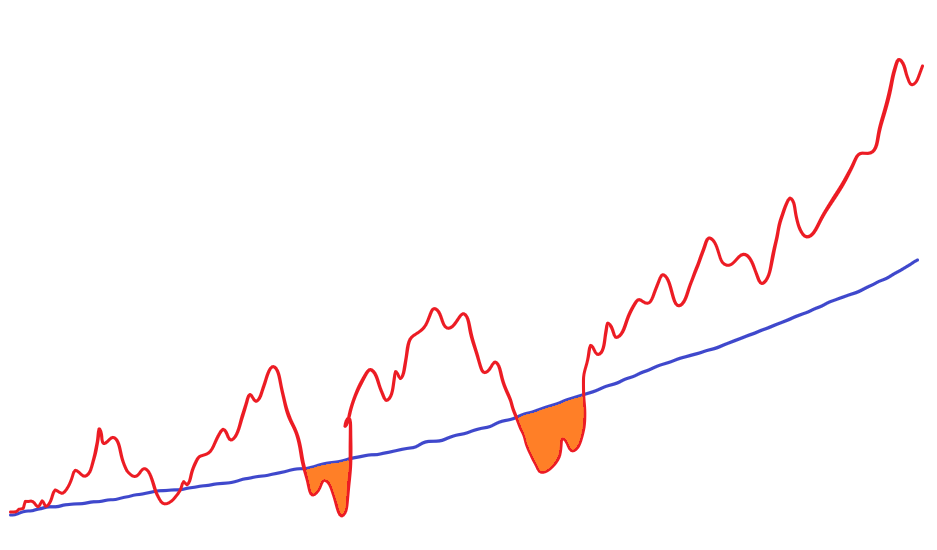
The fact that geometric mean returns (mean log returns) take a parabolic shape as a function of volatility (and hence leverage) implies that the marginal benefit of additional allocation to risky assets is linearly diminishing and eventually negative when volatility exceeds Sharpe ratio. This is illustrated in the figure below. Furthermore, the marginal benefit difference is exactly equal to Sharpe ratio difference between portfolios. Thus, at any given level of volatility, increasing allocation to risky assets is more attractive for a portfolio with a higher Sharpe ratio.
Leveraging a portfolio with a higher Sharpe ratio to achieve a common target volatility level across portfolios leads to greater wealth. This is especially evident as the target volatility increases.
On average, the 60/40 portfolio leveraged to 1x all-equity portfolio volatility outperformed the all-equity portfolio by 0.81%, while the 60/40 portfolio leveraged to 2x all-equity volatility outperformed the 2x leveraged stocks portfolio by 1.64%. The 60/40 portfolio leveraged to 1x and 2x all-equity portfolio volatility outperformed the all-equity portfolio in 68.9% and 68.4% of the 10-year periods, respectively.
On average, calculated across all months, the levered 60/40 portfolio exhibits the lowest mean drawdown, with figures of 11.91% for levered bonds, 10.47% for the levered 60/40 portfolio, and 12.48% for stocks.
It is understandable that many investors either can’t or don’t want to use leverage and therefore stick with the sub-optimal all-equities portfolio. However, for those willing to leverage, it becomes very challenging to justify an all-equity portfolio that foregoes the benefits of diversification which only increase as target volatility increases.
In short, it is about maximizing the Sharpe ratio and leveraging to the desired level of risk.


 Men då är jag lat på vissa sätt, men kan samtidigt lägga hur mycket tid på teoretiska beräkningar (ibland)… så jag är inte facit.

 ?
?