Lägesuppdatering Halvåret 2022 - Hur ser Makron, trenderna etc ut?

Vi går nu in i H2 för 2022 och det blåser lite hårdare vindar på börsen än på länge. Mycket drivet av:

  • En oro att inflationen fortsätter att urholka konsumenternas köpkraft, vilket kan leda till försämrad tillväxt…
  • Och att dem räntehöjningar vi sett (tack vare inflationen) kommer fortsätta, samt påverka ekonomin. Detta då höjda räntor leder till högre avkastningskrav för företagen, vilket leder till färre tillväxtinvesteringar, vilket sänker bolagens förväntade tillväxt.

Som bakgrund så är jag ingen makro-investerare. Jag fokuserar på bolagsanalys när oddsen ligger på min sida, samt investerar mycket kvantitativt efter faktorer. Men jag tycker ändå att makro är intressant, inte som tillämpning för mig själv, utan för att sätta mina förväntningar framåt och sätta investeringarna i ett större kontext. Jag har därmed tagit fram lite verktyg till mig själv, som jag kommer redovisa nedan. Tanken är att med jämna mellanrum (obestämt hur tätt ännu, men varje kvartal eller halvår ter sig lagom) få en överblick att sätta fingret på miljön mina bolag befinner sig i.

Fokusområde 1 - Trend
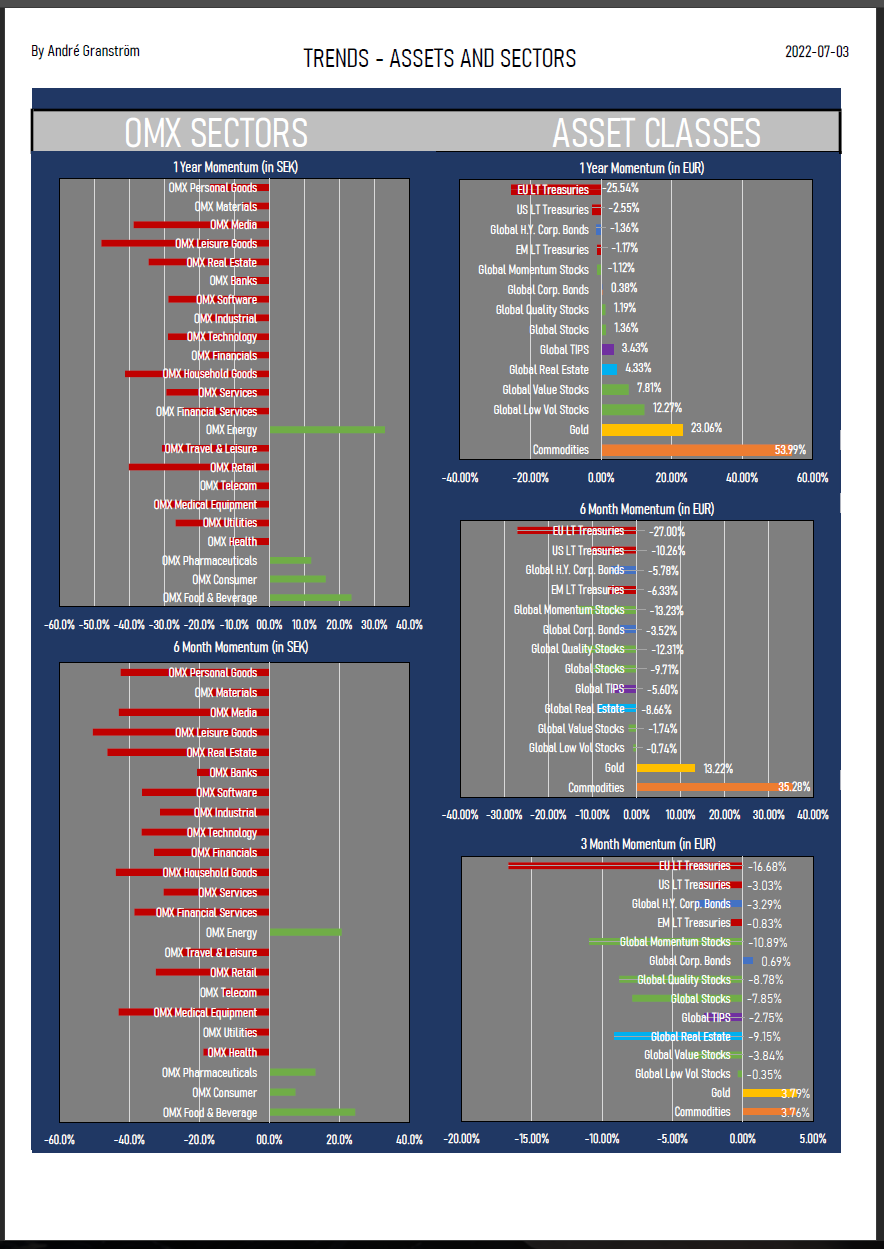
Analysen syftar i att kolla hur de stora tillgångslagen rört sig på sistone, samt även de olika sektorerna på Stockholmsbörsen. För en momentum-investerare kan detta användas för att allokera till de sektorer som gått bäst. För en värdeinvesterare kan det vara intressant att leta guldkorn i nedpressade sektorer. För en passiv investerare kan det vara intressant att få ett större perspektiv hur individuella delar rört sig. Kan även ge försmak för att diversifiera bortom Aktiemarknadsindex & Räntor, till att tex lägga till lite Guld, Råvaror, faktorer etc.
Mina Tankar 1 - Trend:
Fördelningen ser ut som ett typexempel för ett klimat där vi har hög inflation, högre räntor och lägre förväntad tillväxt.

Bland aktier har låg-volatilitet gått bäst. Dessa aktier har en tendens att överprestera i tuffare tider, då det ofta är stabila bolag med god, jämn intjäningsförmåga. Tillväxten är inte fantastisk, men när räntorna rör sig åt fel håll glömmer marknaden allt som heter tillväxt och fokuserar på lönsamhet och låga multiplar. Detta syns vidare i att Värde-faktorn överpresterat under tidsperioden, dessa bolag påverkas inte lika hårt av högre räntor då deras intjäningsförmåga ligger här och nu. Diskonteringen i en DCF sker exponentiellt högre ju längre ut vi blickar som investerare.

Klart bäst har det gått för råvaror och guld. Ur ett historiskt perspektiv har råvaror presterat bäst i tider av god tillväxt och hög inflation, vilket är vad vi haft under H1 2022. Att guldet landar in på plats 2 kan vara att marknaden ser vissa orosmoln framåt avseende tillväxten, då guld historiskt presterat bäst i tider av hög inflation och låg tillväxt.

Kikar vi på sektorerna så är det tydligt att Stockholmsbörsen backat på bred front. Energi, mediciner, konsumentvaror och Mat & Dryck har klarat sig bäst. Samtliga är sektorer som generellt är mindre priskänsliga, där vi fortsätter konsumera trots prishöjningar.

Fokusområde 2 - Sentiment
En snabb blick in i investerarpsyket just nu. Hur negativa är marknaden, och hur har sentimentet utvecklats? För den som inte kan hålla fingrarna borta från att försöka bottenfiska, kan detta vara en intressant indikator. Om inget annat så gäller fortfarande "Misery Loves Company", dvs det kanske är lite skönt att se att fler är lite oroade.
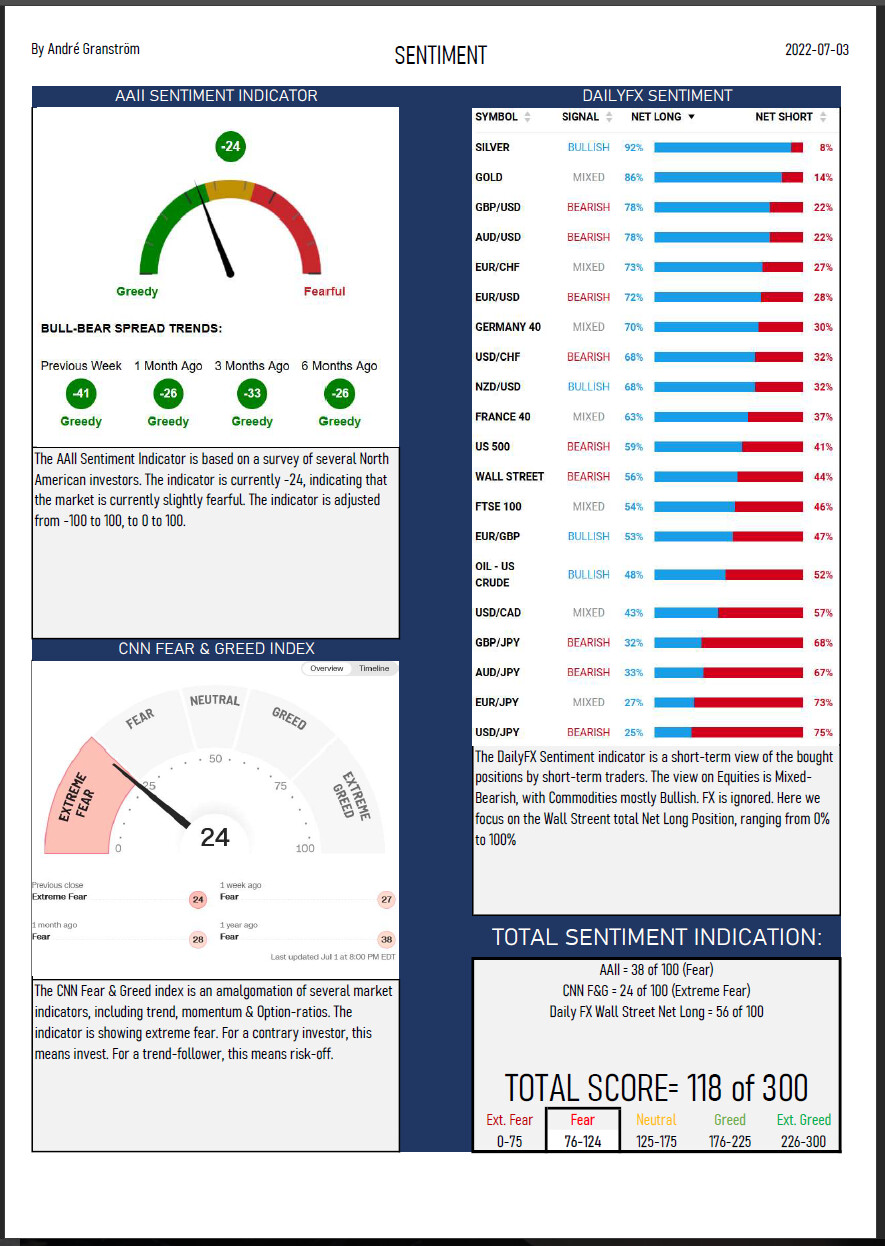
Mina Tankar 2 - Sentiment:
Samtliga av dessa indikatorer är ganska “korta”, dvs dem kan variera starkt från vecka till vecka. Trots detta är det tydligt att det är oroligt där ute, men inte så att “blodet flyter på gatorna”. Kopplar vi ihop detta med sista parametern i Makro-kollen, där vi kikar på andelen aktier i allmänhetens portföljer, så ser vi att på absoluta nivåer ligger vi fortfarande högt. Det är inte en psykologisk botten vi ser just nu.

Fokusområde 3 - Lågkonjuktursrisk
Ett sammansatt mått av flera indikatorer som historiskt varit användbara för att “förutspå” en lågkonjunktur. Dem hjälper inte direkt i tajmingen, då många av dem varnar om en lågkonjunktur “kommande 12-18 månader”, men det kan vara en bra varningens flagga.
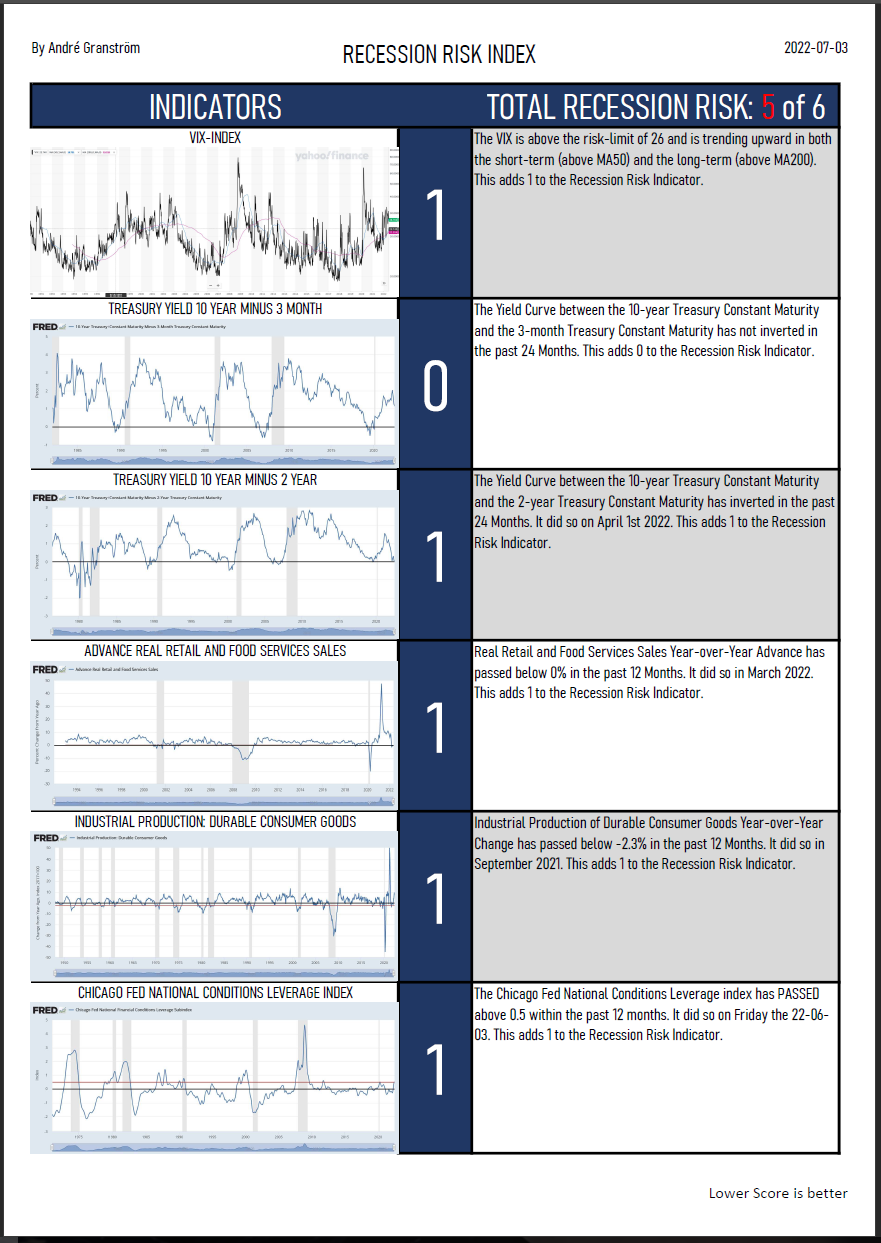
Mina Tankar 3 - Lågkonjunkturrisk:
Nästan samtliga av indikatorerna pekar på att en lågkonjunktur är inkommande. Detta är inget att oroa sig för, det har hänt förr. Det säger inget heller om hur pass lång eller djup lågkonjunkturen kan tänkas bli. Min enda brasklapp är att Indikator 2&3, som kikar efter en inverterad räntekurva, kan vara något påverkade av Centralbankernas agerande. Då dem sitter på en hel del räntepapper, så beroende på deras agerande kan dem även påverka räntekurvan genom säljande och köpande.

Fokusområde 4 - Makro Framtida Tillväxt
Här tar vi tempen på ekonomin. Vi tittar på konsumenternas & företagens syn på läget, hur inflationen utvecklats, inköp hos företagen, utgifter hos konsumenter & hur investerare agerar.
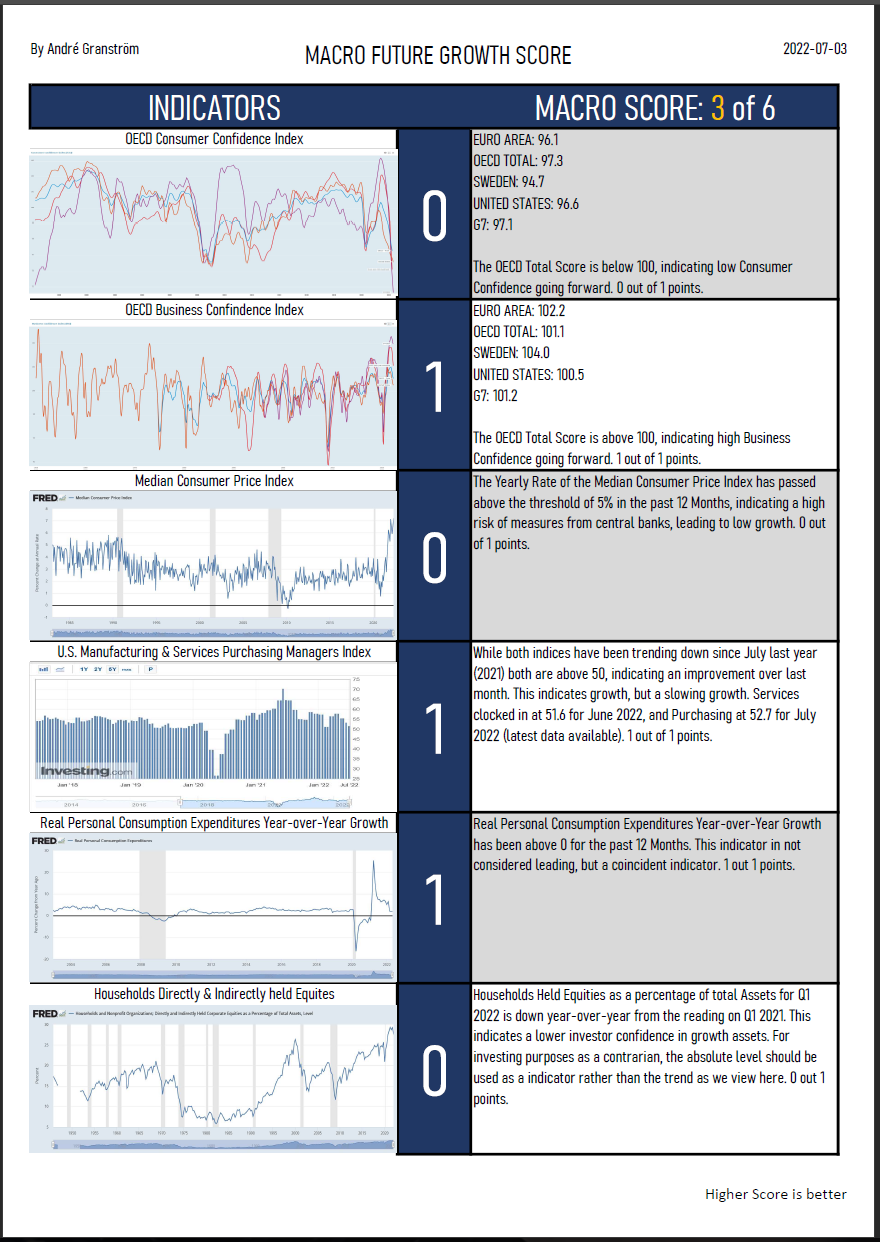
Mina Tankar 4 - Makro:
Blir att tänka på serien Chernobyl. “Not terrible, not great”. Det är tydligt att företagen är fortsatt positiva och synen på konjunkturen skiljer sig mot hur konsumenterna ser. 2 av 3 Konsumentindikatorer ser dåliga ut, medan de 2 företagsindikatorerna ser OK ut.

Det jag mest kikar på här är faktiskt den sista indikatorn. På årsbasis har investerare faktiskt sänkt sin aktieexponering, trots att vi ligger kvar nära historiskt höga nivåer. Detta säger mig att det fortfarande finns en del fallhöjd kvar ifall investerar-kollektivet skulle få panik.

18 gillningar

Intressanta faktorer att titta på. Som en modernare variant på den gamla investeringsklockan.

1 gillning

Tack! Ja, det är lite tanken, att få en känsla för vart vi är och från det, kanske lite hum om vart vi är påväg :slight_smile:

2 gillningar

Vad sticker ut mest för dig @Andre_Granstrom? dvs. vad tycker du man ska lägga särskilt märke till?

Oj, jättebra fråga, är som sagt ingen makro-expert, men det här är vad jag tar med mig:

Många upplever att det känns jobbigt just nu. Men ur ett lite längre perspektiv, och, ursäkta “pessimismen”, det kan bli MYCKET värre. Det betyder inte att jag tror att det blir värre. Vi ser att risken för en inkommande lågkonjuktur är hög, men det ser ut som att det kommer slå hårdare mot konsumenterna än företagen, åtminstone i det lite kortare perspektivet.

Tar även med mig att räntor inte alltid agerar krockkudde, utan det kan vara värt för en investerare att ha lite guld & råvaror i portföljen. Trots att dem inte är naturligt avkastande, så är fler okorrelerande tillgångar i portföljen bra. Det är något jag alltid vetat, men nu sitter det lite djupare rotat :slight_smile:

1 gillning

Vad tänker du då? Kan du måla lite beskrivande?

En del räntor skyddar nog bättre än andra när aktier får ner. Många räntefonder består av företagsobligationer både IG och HY och dessa är starkt korrelerade mot börsen. Medans t.ex långa amerikanska statsobligationer är låg korrelation. Jag håller med om att man ska balansera upp aktier med tillgångar som har lägre korrelation mot varandra.

Har själv både guld, råvaror, statsobligationer USA, Europa och tillväxtmarknader samt realräntor

Det jag ser är väl att vi ur ett historiskt perspektiv fortfarande är väldigt tungt investerade i aktiemarknaden. När det är jobbigt “på riktigt” så förväntar jag mig nog att se ett större skifte över till andra tillgångar, främst räntepapper nu när deras yield börjar gå från orimligt låga till låga nivåer.

Om vi tittar på OECDs confindence index så ligger vi även där på knappast bottennivåer, dvs svarande är inte extremt negativa.

Det som jag tror delvis lett till det extremt låga sentimentet är kontrasten mot förra året. Kika på utvecklingen Retail and Services, helt otroligt vad vi konsumerade under 2021. Detta tillsammans med att vi nu troligen står inför en lågkonjunktur. Här har vi kunnat se den komma, medan CoVid-lågkonjukturen kom hastigt, och sedan stimulerades bort. Så vi är inte riktigt vana, vi får kika hela vägen tillbaka till 2008 för att hitta nästa problemperiod.

Så är det, om det går att sänka räntorna ytterligare. Men som Ray Dalio visade i “How the Economic Machine Works”, så kommer vi ibland till ett läge där det inte går längre. Då kommer aktier och räntor att bete sig väldigt lika. Speciellt räntor med långa durationer.

Värt att länka till den tycker jag:


Det är bara sant att nominella statsobligationer har låg korrelation med aktiemarknaden
när inflationen och räntorna inte stiger oväntat mycket.

Men nu t.ex så har inflationen och räntorna stigit oväntat mycket senaste året,
vilket har gjort att statsobligationer har varit ganska starkt korrelerade
med aktiemarknaden.

Det är bra att du också har realräntor, guld och råvaror i portföljen,
för det hjälper att skydda mot perioder med hög inflation,
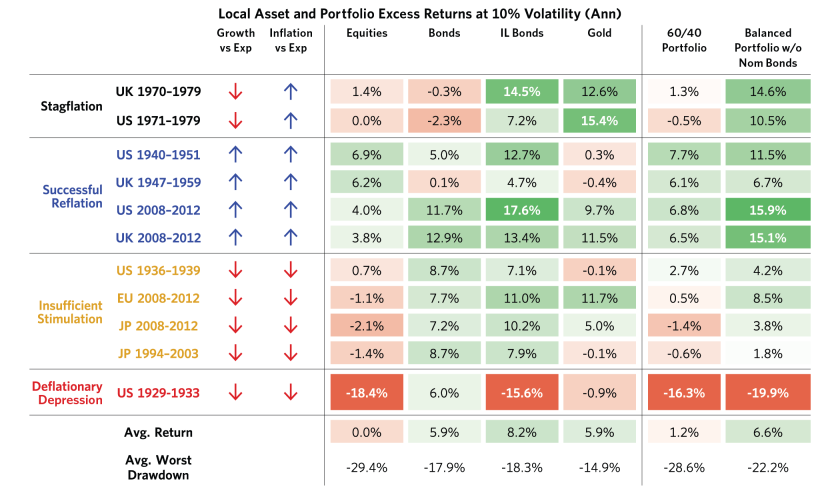
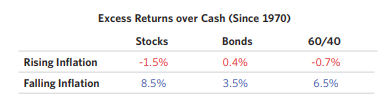
vilket annars straffar en 60/40-portfölj.

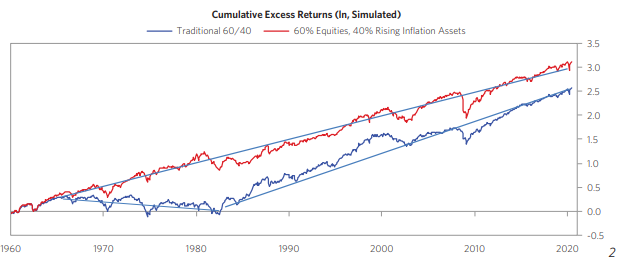
En tänkvärd graf jag postade i en annan tråd som visar att även en traditionell 60/40-portfölj kan underprestera den riskfria räntan över 20 år, eftersom den är så oskyddad mot inflation

Men en 60/40-portfölj som byter ut nominella obligationer mot realräntor, guld och råvaror
klarade sig alltså mycket bättre.

Det finns dock en period där nominella obligationer presterade klart bäst:
depressionen 1930, när deflation var det stora problemet.

Efter det togs ju guldmyntfoten gradvis bort, vilket gav centralbankerna friheten att
försöka stimulera ekonomin genom pengatryckande, vilket är varför
inflation har generellt varit ett större problem än deflation sedan dess.

1 gillning

Tack för att du delar med dig av dina indikatorer! Flera av dem var nya för mig. FREDs hemsida är verkligen en fantastisk resurs för olika makrodata.

Personligen tycker jag att makroanalys är användbart, inte för marknadstiming, men för långsiktig strategisk positionering. Anledningen till att jag nördat ned mig i allvädersportföljer är att jag tror att makroklimatet för aktier kommer vara osäkert kommande decennium (såsom 70-talet). Du får gärna posta här i forumet i samband med dina kvartalsvisa/halvårsvisa uppdateringar av dina indikatorer, jag hade följt det med stort intresse.

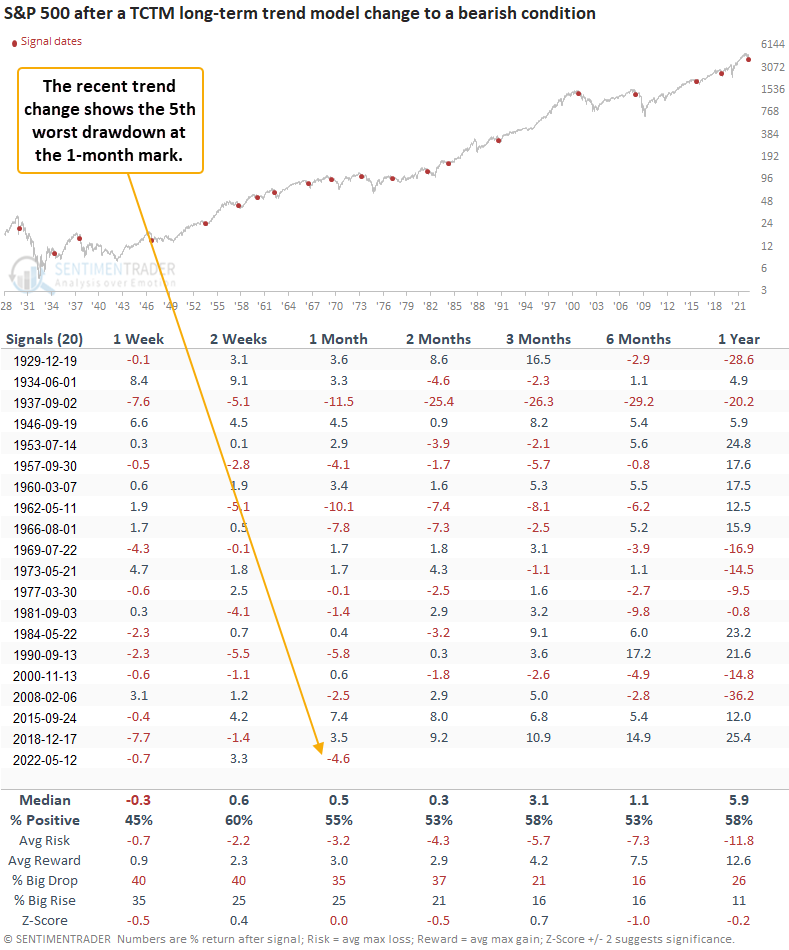
För att försöka bidra till diskussionen följer här en tabell från en makromodell som jag följer, där en signal nyligen triggades i maj:

Vi står vid ett vägskäl nu. Om vi lyckas undvika recession (t.ex. signalerna 2015, 2018) bör botten vara nådd. Om vi däremot går in i recession (t.ex. signalerna 2000, 2008) har vi långt kvar till botten, precis som du skriver.

2 gillningar

Från en läsare som vill vara anonym. Företagsintern makro (rensad för företagets interna info):


INTRODUCTION

Almost a quarter has passed since the last macroeconomic update. Mario Dragi was Prime Minister of Italy, Russian gas was flowing through Nord Stream 1 (albeit at reduced capacity) and a one-Euro coin could reliably entitle you to a one-dollar bill.

Back at the end of June, potential impacts on corporate earnings were introduced through two focal questions:

  • How long will intense inflationary pressure and inflation expectations last?
  • Will central bank/government response to inflation lead economies into a recession? If so, how prolonged and painful will it be?

In the spirit of continuity, here’s a brief wrap-up of the latest developments in inflation readings and monetary policy:

  • Overall, there were no major surprises on this front versus what was expected in the previous macro note; central banks around the globe have ramped-up monetary tightening through interest rate rises.
  • US rates now stand at 2.25% (from 0.25% in Mar’22) and are due for another 0.75 to 1.0% hike next week (link followed by the more recent link) on the backdrop of a “disappointing” August CPI rate of 8.5% annualised.
  • The ECB just increased rates by 0.75% last week to reach 1.25% (they were still at 0% back in Jun’22) (link). Again, the challenges Lagarde faces are not the same as her counterpart Powell due to (a) the fragmentation of the EU economy (good example with Italy here) and (b) the closer-to-home, acute energy crisis, which has been the most influential factor behind surging inflation and is expected to ease in 2023. The consensus is that these two factors will prevent rates rises of the same magnitude in the coming months (link with bonus funny Swissquote advert).

Before jumping to the ramifications on each sector, there is another crucial topic which deserves a dedicated section in the introduction: the unfolding energy crisis. As energy is a vital raw input in any economy (“land” in the four factors of production if we think back at our economics 101), the effects of its price skyrocketing are far-reaching and ripple through every corner of the economy. Consider the ominous graph below(taken from this 11th Aug’22 article, fortunately prices have eased slightly since):

image.png

Without getting into the debate of European energy sovereignty (link) - and whether historical prices were sustainable/under-pricing risks - it’s easy to imagine that when households, businesses and governments have been used to relatively stable energy prices for over a decade and that now for the same consumption their bills could quintuple, the consequences without state intervention could be dramatic. In advanced, services-oriented economies, household consumption accounts for 70%+ of GDP. Therefore any reduction in a consumer’s ability to save (and therefore consume in the future) will invariably spread to other market participants. Spending on non-essentials ("discretionaries’') could plummet, ability to repay mortgages compromised (increasing defaults/credit risk), cause businesses reliant on energy as an input (manufacturing, utilities, raw materials) to become uncompetitive and potentially insolvable if unable to meet financing obligations and the list goes on.

Because the stakes are so high, governments (ones that wish to be re-elected at least) cannot afford to sit by idly and are drawing up local and pan-European plans to influence these fundamental price mechanisms. While some are more targeted for specific pockets in the economy, the general idea is to protect households - especially the most vulnerable - and businesses by limiting the impact of energy price surges. Since the last note, the ECB has warmed up to the idea of large windfall taxes levied on fossil fuel suppliers (140bn€ plan outlined here) to fund schemes such as the one outlined by France recently, capping energy price hikes at +15% maximum in 2023 (link).


SEGMENTS II: MACRO TRENDS

Across the board, most analyst notes and financial news on the topic offer few optimistic and contrarian viewpoints. Keywords such as “supply chain woes”, “inflationary pressure” and “cost headwinds” all but flood most recent publications. The general consensus is that cost bases are under tremendous strain - red hot labour market, energy crisis, China’s zero covid (pick your poison!) - which in turn stress operating margins which in turn could impact business discretionary spending/demand on IT services. Evaluating which customers are most likely to wind down their IT investment plans and where can this potential lost business be reallocated to is no easy task and more analysis - especially on our own microeconomic side - is required (CRM data, for example). The intention behind the following comments amount more to a first big picture/“start wide” step into these discussions.

1. Finance - slight downgrade - “Resilient but not impervious”:

  • Revenue from lending activities, which are amplified by interest rate increases, remains the bread-and-butter of large retail banks.
  • However, this seemingly simple equation is challenged by the combination of (i) brutal monetary tightening and (ii) the impact of the energy crisis. While most governments will have schemes to limit price hikes, a 100% coverage would be too expensive, so some increases will be passed on to consumers and businesses, therefore increasing the risk of default or refinancing on these loans.
  • On the investment banking side, the warnings are also flash red (link)
  • There is a chance the remains of the covid era savings + committed government support can preserve profit margins of our large portfolio of banks, but it will be a tightrope in the near-future.
  • The next Financial Stability review from the ECB comes out in November and is one of the best reads on the subject.
  1. Gov, edu & healthcare - uneven situation but mostly on the negative
  • After providing some of the most generous packages in recent history to save economies from the depths of the pandemic, Western governments have had no time to restore their balance sheets and seem compelled to act anew on the back of the unfolding energy crisis.
  • The mechanics of windfall taxes or price caps on Russian oil/gas (link) are complex and it is unclear whether they will be sufficient in themselves to achieve the desired outcome of consumer protection.
  • As governments are both stretched and highly wary of additional fiscal stimulus, which risks stoking inflation even higher, it is likely IT investments will come under increased scrutiny or budgets forgone in favor of the fight on the energy price “war”
  • However, this is not the case for Norway or the Middle-East, which are prime benefactors of the oil & gas recent oil and gas rallies (of which OPEC is determined to keep going) and where our efforts should be maintained

3. Manufacturing - Highly deteriorated

  • This is perhaps the segment that is the most severely impacted by the energy crisis, along with utilities. News about raw material producers having to halt production or downright warn on impending insolvency are becoming more frequent (example with metals industry here).
  • Furthermore, while more discreet recently, 2 factors continue to weigh on global supply chains: (i) China’s continued commitment to zero-covid (link) and the (ii) chip shortage for non-PC industries (link). Most manufacturers have in fact been able to navigate these constraints and preserve margins by reprioritising sales of higher-priced products resulting in lower volumes of goods traded but to similar top-line figures. This is true of the auto industry (link) despite lingering worries on chip availability. This mood is not necessarily shared by all auto OEMs, such as the example of China’s Geely and the more optimistic tone following Q2 earnings at Mercedes.
  • Overall, focus on costs/margin squeeze and less on demand reduction heading into a potential recession.

4. Information technology - same as last note

  • Recent headlines have been in continuation of the previous note. Snap’s recent announcement of a 20% cut to its workforce definitely stands out by its sheer scale but is far from being the only player to reign in hiring or downright layoff staff. Quite good exhaustive yet succinct list from Yahoo Finance here.
  • Again the headlines focus on recent swings in labour turnover or market valuations but seldom question the underlying financial strength of our strategic partners, for example.
  • Good material here includes earning reports from our competitors (Alten and Accenture next week).

5. Services - slight downgrade

  • While our own numbers confirm the post-lockdown boom in services, the reductions of household purchasing power driven by increased energy prices cloud blow some steam off the recent “revenge spending”. Until now, higher costs have been for the most part passed on to willing customers across most services (McDonalds, Airlines …)
  • On the hospitality front, Accor had announced solid H1 2022 figures only to revise downwards its outlook.
  • In air travel, Ryanair announced a “strong but fragile” recovery back in July. However, Airbus is not expecting lower passenger numbers to reduce demand for jets (link), which could also apply to some of our parts manufacturers (Safran, Thales).

6. Retail & wholesale - same as last note

  • Overall, the situation is mostly unchanged vs the previous note. While mentions of supply chains worries are unavoidable, recent news on discretionary consumer goods seem upbeat: Inditex , LVMH or Fnac Darty (stable/solid H1 2022)
  • The “staples” side is definitely gloomier, with clear warnings on profitability levels from the likes of Target and Walmart.While these are US retailers, there undoubtable parallels with their European counterparts.
  1. Telecoms - same as last note
  • Nothing really new to add vs the previous note. While Telcos are also expected to have to adapt to higher cost bases, the consensus is that these “un-glamourous” businesses are reliable/robust in situations of economic downturn.

8. Utilities & energy - downgrade

  • Clear cut winners in the previous note, the situation has changed materially, with the distinction between energy suppliers and utility companies in stark contrast
  • Energy providers or supplies/traders of fossil fuels: the bumper profits in the sector were already making headlines back at the end of June. What has changed is the willingness for government intervention in the sector in the shape of a one-off, “redistributive” tax bill. This could definitely hinder IT discretionary spending depending on the magnitude of the levy for clients like Total.
  • On the utilities side, the situation has escalated to the point where government bailouts are required, such as for Germany’s Uniper (link). While circumstances are not the same depending on the country and type of utility and country, the sector is under severe stress. We could start to feel the pinch at EDF (already under pressure from renationalisation and restarting nuclear engines), ENGIE and Veolia. Mitigating circumstances for the first two is that they have been reliable top customers for over a decade (from 18 to 28m€ in 2021 for EDF and from 24 to 27m€ for ENGIE for the same period).

9. Transport - uneven

  • Not much to add on this segment to which we are marginally exposed to. Fuel costs continue to weigh on the sector but recent headlines have been uneven, with Maersk continuing its bumper profits run - similar to that of energy providers - while the most recent “shock” came from Fedex. This is because Fedex is used as a proxy for perceived economic health and it announced issues on the demand side rather than the usual supply side challenges.
2 gillningar