Jag snubblade på en YT-video på How Money Works idag som var väldigt fascinerande och sätter fingret på exakt hur subjektivt och hierarkiskt våra hjärnor tänker och sätter krokben för oss psykologiskt. Oavsett vår absoluta nivå av inkomst, rikedom och så vidare.
Den refererar till en rapport från banken Goldman Sachs som utforskat olika inkomsttagares tillfredsställelse med sina finanser i USA. Det är framför allt en bild med fem olika inkomstgrupper denominerat i USD som jag tycker var det intressantaste i videon och i rapporten.
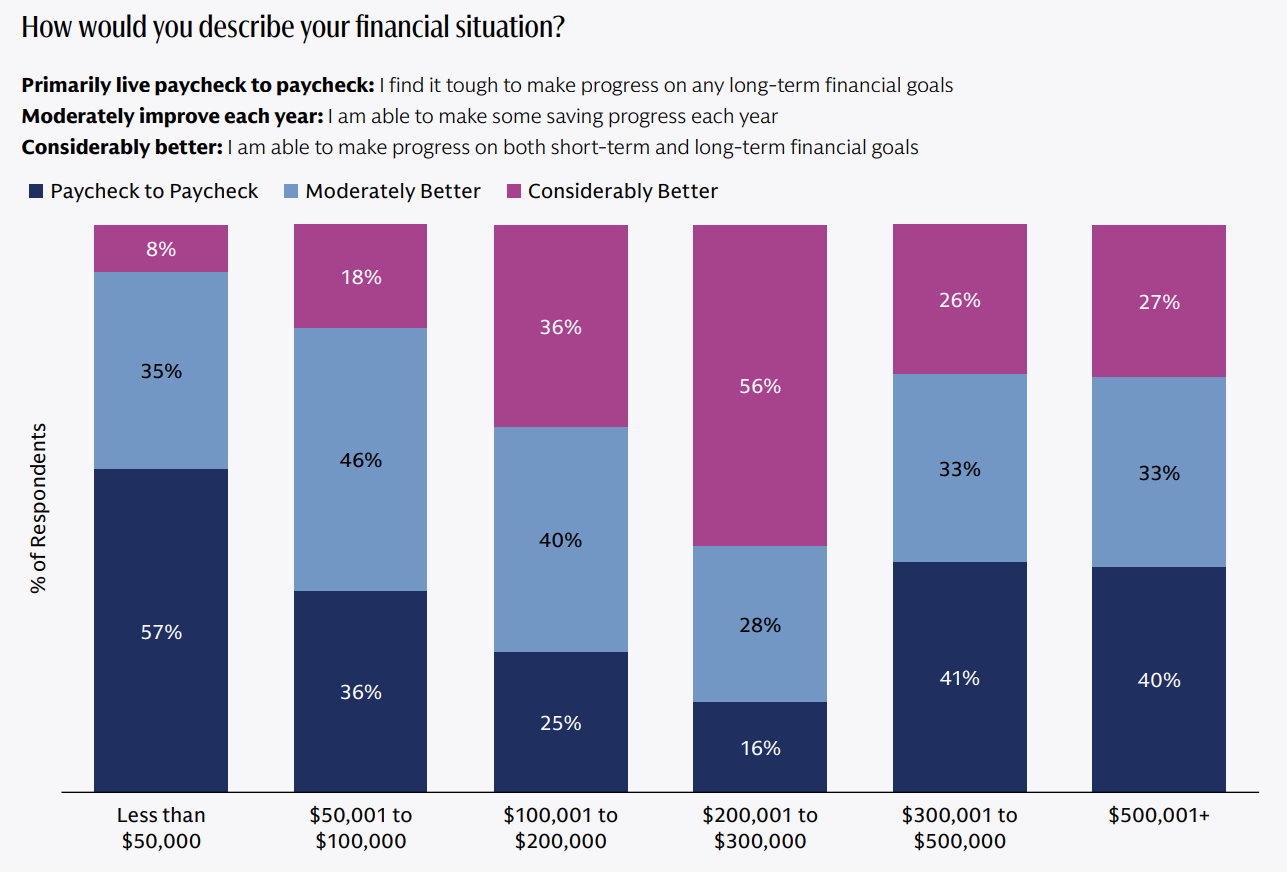
Den visar alltså precis som man kan tänka sig att de fattigaste (den absoluta majoriteten) som tjänar under 50 000 USD per år är mest överrepresenterad bland de som anser sig leva lön till lön, 57%.
Men… De absolut mest subjektivt nöjda är de som förvisso tjänar väldigt mycket, $200K-300K/året, men absolut inte de som tjänar $500K/året och bortom det. Det kan tyckas ointuitivt, men YT-videon förklarar väldigt bra sociologiskt en teori som är väldigt psykologisk sannolik till varför det blir såhär. Snabb transkriberat av mig:
There are between 50-60 million dollar millionaires in the world at the moment. Among this cohort of globally wealthy residents, 1% of those with net worths over $1M hold 33% of their collective wealth.
Nobody feels poorer every day today than really rich people. Most people generally interact day to day with other peers in their direct income level, on average. If you work an upper middle class professional job, there’s a good chance your partner does, too. For example. You will probably live in a neighborhood with others from the upper middle class. Your friends probably chose somewhat similar lifestyles and locations, etc.
An article published by the Journal of Nature tracked over 72 million Facebook connections found that socioeconomic status was the main predictor of who you were friends with. That means that day in and day out, on average, you’re going to interact with people living a somewhat similar lifestyle to yours.
Sure, with some exceptions with regards to income, education etc. But for the most part with people who may earn 10-20% more or less than you, on average. With few larger exceptions.
Where this gets really interesting though, is by moving the scale to the very top. It is only here that extreme inequality is visible within a decile of wealth/income. If you earn $500K/year as an analyst at a private equity firm, you are definitely wealthy according to almost anybody’s standards. But compared to your partner who may be making 10 million USD a year, you are basically poor.
Nowhere else on the income/wealth scale are you as likely to work, socialize and have a partner who earns as much as 20 times more or less than you. There are several orders of magnitude more income and wealth variance within the global top 1%, which means that the lifestyle comparisons that wealthy people make is far more psychologically damaging to them.
If you work in roof construction, your colleagues may try to convince you that you need to lease a new Ford F150 truck. If you work in a hedge fund, your colleagues might try to convince you to fly private to Basel to network. This might be the core reason why people in the report who earn “only” $200-300K/year feel the most subjective satisfaction with their finances. They are still mostly exposed to to more socioeconomically average people. This phenomenon is dubbed “socioeconomic fractality”.
Vad får ni för tankar, åsikter, insikter och reflektioner när ni läser och ser det här? Igenkänning? Total oigenkänning? Sorg? Skadeglädje? Ut med allt ni ruvar på 
Jag tycker det är fascinerande att observera hur vi som art är så biologiskt programmerade till jämförelser med vår direkta närhet att vi på gruppnivå kan ställa till det för oss på det här sättet. Även när vi tjänar så mycket som 500 000 USD+ per år.