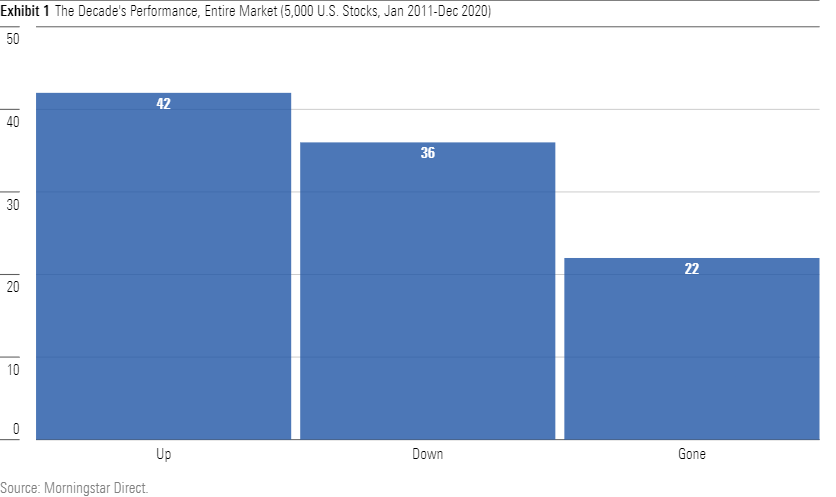
The numbers clearly support Bessembinder’s argument. Although the Morningstar U.S. Stock Index enjoyed a 13.90% annualized gain for the decade, only 42% of individual equities finished in the black. Nearly as many (36%) posted 10-year losses. The final 22% vanished. While I did not investigate the fates of the dead, Bessembinder’s research suggests that half the expired stocks were acquired, with decent results, while the other half were delisted, with dire consequences. Even during a decade marked by an almost uninterrupted bull market, the average stock wasn’t much good.
Större bolag är mindre riskfyllda (då de oftare är lönsamma)
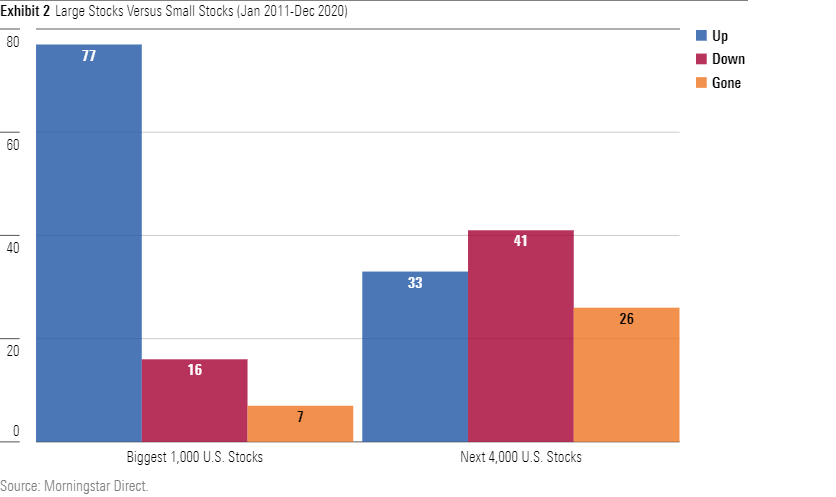
The larger companies were far more reliable than their smaller rivals. Whereas 42% of the overall stock universe persisted for the full decade and posted a positive total return, 77% of the biggest 1,000 companies did so. Conversely, once the larger fish had been removed from the list, the success ratio of the next 4,000 stocks dropped to just 33%. Even though the decade contained a prolonged bull market, most smaller stocks recorded a loss, not a gain.
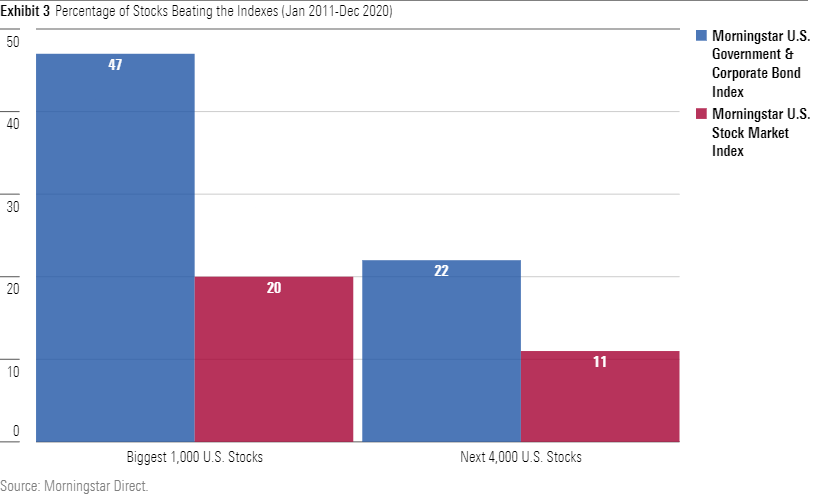
Andel aktier som slog index (ränteindex = blått, aktieindex = rött)
Once again, the disparity between the size groups is apparent. A randomly chosen company from the biggest 1,000 list was more than twice as likely to survive the period and surpass the bond index than was a stock picked from the next 4,000. The precept that most stocks disappoint applied much more to secondary stocks than to larger organizations.
Kontentan
For now, suffice it to say that Bessembinder’s research remains valid. His conclusion that most stocks disappoint cannot be disputed.
Om “most stocks dissapoint” och att större bolag är bättre än små så drar jag slutsatsen att S&P 500 är bättre än Russel 3000. En index fond med färre bolag skulle vara bättre än en med fler, och att efterfrågan på småbolagsfonder borde vara låg, pga konstant underprestation.
En slutsats kan vara att ett globalt 2 triljoner tech företag är bätttre än en mindre lokal aktör som ICA.
Problemet är att ICA nog räknas som ett stort bolag i Sverige. Stora bolag i USA omsätter mer pengar än vad vissa länder gör. Det är inte säkert man kan dra samma slutsatser från omx-30 som från Nasdaq-30. Det är en annan liga med andra spelregler.
Grafen visar ju bara huruvida de gick bättre eller sämre än index, inte med hur mycket. Visst det finns fler skitbolag i Russel än i S&P, men det finns säkert också fler raketer (typ som EVO här i Sverige) som kompenserar för alla skitbolag.
Nä, för man kollar ju hur många aktier som slår index över en 10-årsperiod. De som tillkommer under tiden slår inte index över 10 år, utan isåfall över <10 år.
Itressant artikel och diskussion. Jag kommer ihåg att när jag tittade på den här videon av Ben Felix då verkade take home message vara: investera brett så du fångar de få och svårhittade bolag som står för avkastningen
Så lite samma tanke som redan kommer fram här ovan
Men artikeln verkar peka åt det motsatta hållet. Investera i storbolagsindex, mindre bolag underpresterar. Vi får väl se. Jah behåller Handelsbankens dyra globala småbolagsindexfond lite till åtmindstonde!