Från Bogleheads wiki:
The investment performance of an equal weight stock index will be affected by its greater holdings of smaller companies, any value tilt the weighting brings to the index, and the effects of quarterly rebalancing.
S&P has back-tested results for the S&P EW 500 index going back to 1990 (the index was created in January, 2003.) Over the (1990 - 2009) period, the compounded annual return of equal weight 500 index outperformed the cap weight 500 index by +1.8%, but with considerable variance over market cycles.
S&P reports that the EWI would have outperformed the S&P 500 in the early nineties; underperformed during the 1994 - 1999 period dominated by technology growth stocks; and outperformed over the 2000 - 2009 period. The S&P EW index tends to have higher volatility than the S&P 500.
Over the 2002 - 2007 period the annualized standard deviation was 10.97% for the S&P EWI versus 8.61% for the S&P 500. Correlation of the S&P EW Index to the S&P 500 Index ranged from 84% to 98% (1990 - 2009), with the lowest correlations occurring during the 2000 - 2002 bear market.
The following table provides annual returns for the S&P EWI.>
S&P Equal Weighted 500 Index Returns
Year S&P EW 500 TR S&P 500 TR 2018 −7.64% −4.64% 2017 +18.90% +21.83% 2016 +14.80% +11.96% 2015 −2.20% +1.38% 2014 +14.49% +13.85% 2013 +36.16% +32.39% 2012 +17.65% +16.00% 2011 −0.11% +2.11% 2010 +21.91% +15.05% 2009 +46.31% +26.46% 2008 −39.72% −37.00% 2007 +1.53% +5.49% 2006 +15.08% +15.79% 2005 +8.06% +4.91% 2004 +10.88%
Här är en riktigt bra tråd på ämnet från Bogleheads där de diskuterar fonden RSP som är en likaviktad S&P500-fond.
Några höjdpunkter (min fetstil):
It is normal for the stock market to be dominated by a few large companies, that’s just the way it is. And usually the companies that are at the top have a good deal of faddishness, bubbliness, and irrationality to them, and that’s just the way it is, too. And the odd thing is that the “fundamental indexing” products that specifically seek to avoid participation in the craziness have been out for well over a decade, and haven’t proved to perform all that differently from cap-weighted products.
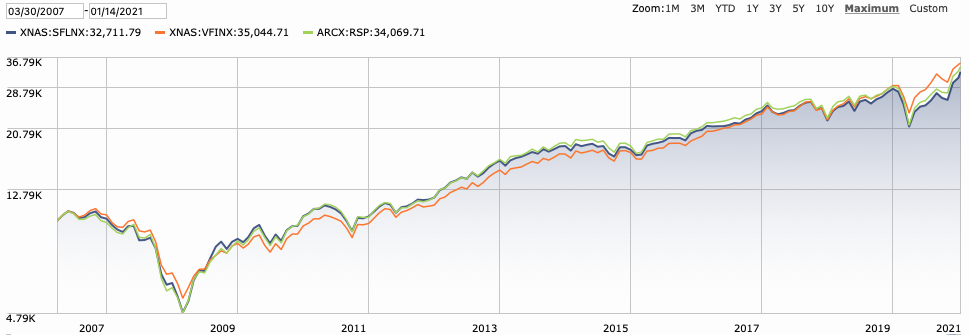
Let’s not argue about which is better , the S&P 500 fund (orange) or the Schwab Fundamental US Large Company Index Fund (blue), let’s just observe that top-heavy or not, the S&P 500 fund just didn’t stink all that badly.
In fact, despite trying to avoid the fundamentally unsound companies, the fundamental-weighted fund actually took deeper dives in 2008-2009 and this year. And the same thing held true for RSP (green).
You’d think trying to stay out of the craziest stocks would moderate volatility, it sounds like it would do that, but it hasn’t done that.
och
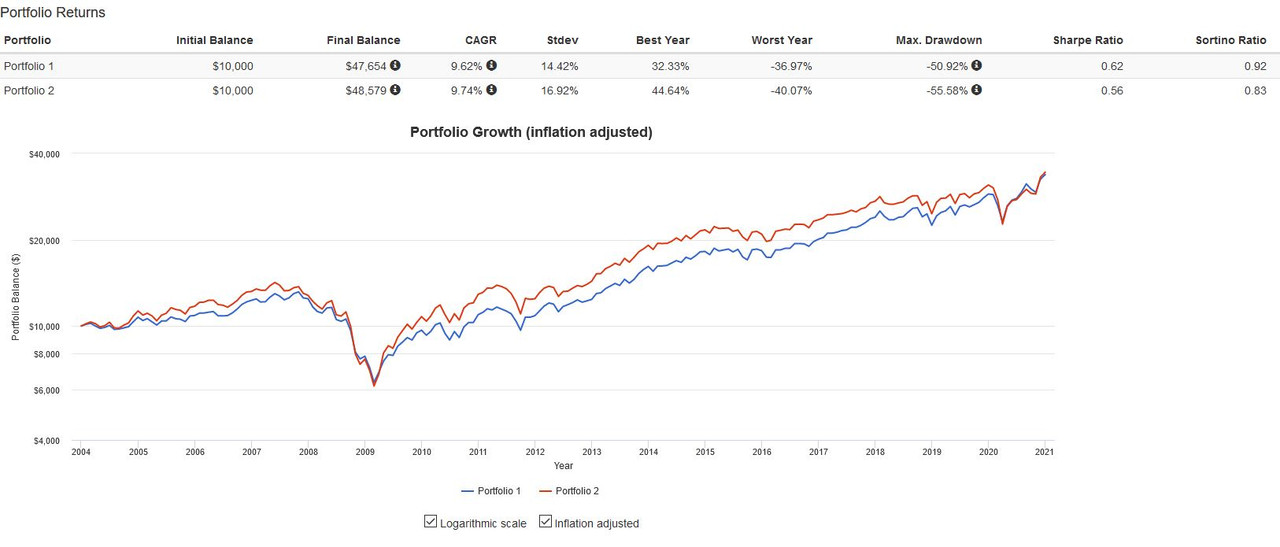
while RSP (=equali weight) had slightly better CAGR (9.74% vs 9.62%) it had LOWER risk adjusted returns per sharpe and sortino ratios. It had higher standard deviation too.
whatever gains it had over S&P starting 4/30/2009 gave it up by 3/31/2020. So the 10 year outperformance was lost in year 11. It started ahead again, but only around 11/30/2020 and there’s no guarantee that will continue and if it does, how long? How patient are you?
markets are generally dominated by a few companies. Only 4% of all companies have created the value of the market since 1926 (source: https://papers.ssrn.com/sol3/papers.cfm … id=2900447)
The four most dangerous words in investing are “This time is different”. Sir John Templeton
samt
If two companies in the S&P 500 merge, RSP will cut its exposure to the combined business in half. Does that make sense?
If an S&P 500 company spins off another company big enough to be in the S&P 500 company, RSP will double its exposure to the split businesses. Does that make sense?
Market cap investing gives us an equal share of all businesses, for which we must pay the going rate. So-called “equal weight” investing says we ought to buy an outsized share of smaller businesses. This incurs trading costs and is unlikely to yield a higher long run return. And if you believe in the size factor, there are more efficient ways to get it.
Från en annan tråd:
As for RSP, the statement that it “provides a better risk/return profile than total market” is factually incorrect. It just hasn’t been so.
RSP has had slightly higher return (CAGR), but higher risk by standard deviation and other measures–as you’d expect because equal weighting is a small-cap tilt relative to the market. By two standard measures of risk-adjusted return, the Sharpe and Sortino ratios, the total market has had a better risk-adjusted return.
If you go in yourself and set the end date to 12/31/2019 you’ll see that even if you exclude 2020, the risk-adjusted return was still (microscopically) higher for VTI.

samt
Market Cap Weighted is the cheapest and most available. Although it doesn’t show up as having a momentum factor (because it is considered the reference point) it does, because it systematically holds more stocks and sectors with high market caps. It also tends to hold a disproportionate amount of large cap stocks.
Equal Weight has higher volatility because of its higher exposure to small and value stocks. However, it essentially has negative exposure to momentum because it rebalances often (and rebalancing is most effective when done less frequently because it takes advantage of momentum). On the flip side, Equal Weight’s higher volatility improves returns with accumulation portfolios and when it’s rebalanced against bonds or international stocks. But, of course, volatility is not desirable for distribution portfolios.
Sector Equal Weight, like standard Equal Weight has less momentum and less large cap allocation than Market Cap does, but actually has lower volatility. However, there seems to be more idiosyncratic risk because you’ll have about 50% of your money in sectors that respectively make up 2 or 3% of the market by capitalization.