Det verkar inte ha gällt historiskt iaf.
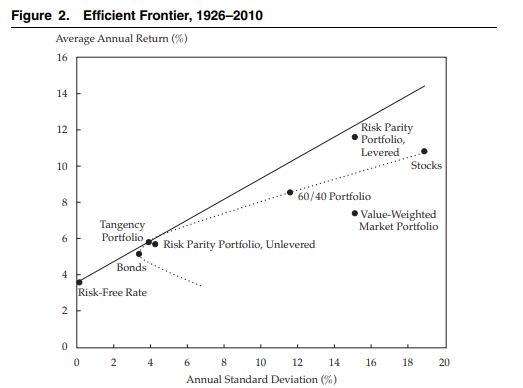
Ur Leverage Aversion and Risk Parity :
They found that low-beta stocks have higher risk-adjusted returns than high-beta stocks in the United States and in global stock markets, safer corporate bonds have higher riskadjusted returns than do riskier bonds, safer shortmaturity U.S. Treasuries offer higher risk-adjusted returns than do riskier long-maturity ones, and so on within several other asset classes.
Consider an investor who would like a higher expected return than that of the tangency portfolio and is willing to accept the extra risk but is not willing (or allowed) to use any leverage. What portfolio will she choose? Preferring an unlevered portfolio with more stocks than the tangency portfolio, she may invest all her money in stocks. The presence of such investors changes the CAPM conclusions because they assume that everyone will invest on the line in the mean–volatility diagram. Thus, the tangency portfolio is not equal to the market portfolio given the existence of leverage-averse investors.
Hence, leverage aversion breaks the standard CAPM, and according to this theory, the highest risk-adjusted return is achieved not by the market but, rather, by a portfolio that overweights safer assets. Thus, an investor who is less leverage averse (or less leverage constrained) than the average investor can benefit by overweighting low-beta assets, underweighting high-beta assets, and applying some leverage to the resulting portfolio.
Med andra ord, på grund av “leverage aversion” hos många individer och institutioner så har man historiskt kunna uppnå högre avkastning till lägre risk jämfört med 100% aktier genom att applicera hävstång till en välbalanserad allvädersportfölj.
1 gillning